
Who’s Upholding Abstinence?
By: Deborah Schroeder
December 3, 2025
Cultural norms have shifted. Over time, dating, engagement, and marriage customs and practices have trended in a different direction. Consider these contrasting scenarios between then and now:
THEN…
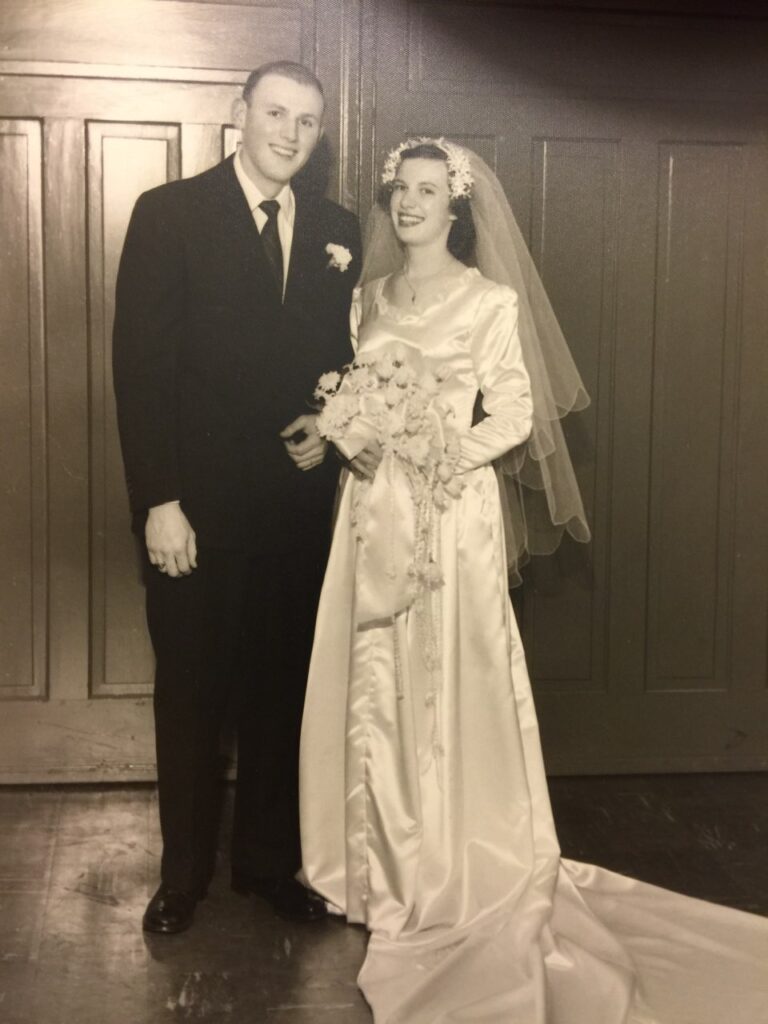
On February 5, 1948, Walter Freiberg and Ruth Johnson were joined together in marriage at Trinity Lutheran Church in Jackson, Michigan. Dressed in a new dark suit and tie, with a white carnation boutonniere, Walt stood before family and friends in front of the altar with his cousin, Roland, and his brothers-in-law, Phil and Owen. He eagerly watched for his Bride to make her way down the aisle. She was preceded by her older sister, Katie, younger sister, Helen, and sister-in-law, Minnie. The bridesmaids’ floor-length satin gowns were rose-colored, and off-the-shoulder. The bride made her entrance in a long sleeve white satin gown with a beautiful train and a waist-length veil. She carried a bouquet of mixed white flowers. The late Reverend Lyle Paulsen officiated the ceremony, culminating a period of pre-marital counseling with the two church members. He offered words from Scripture concerning marriage, a brief wedding message, and led them in stating their vows: …for better or worse…in sickness and in health…for richer or poorer…till death do us part. The reception followed in the church basement as the happy couple greeted their guests and shared wedding cake and punch. Following a few speeches and well wishes, the couple prepared to make their exit from the front door down the cement steps to the street level. Guests preceded them to form lines on either side of the steps, ready to toss rice, and cheer them on. Their car was parked against the curb in front of the church. The groom carefully helped his bride down the steps and into the front passenger seat as she lifted the hem of her gown to avoid staining it on the snowy sidewalk. With excitement and joy, they drove off to the Purdue University campus in West Lafayette, Indiana. They had recently rented a small, furnished apartment near campus so Walt could complete his degree in mechanical engineering on the GI Bill. The “big event” was not so much the wedding day in and of itself. The wedding day marked the beginning of the big event, which was the journey together for the rest of their lives!
NOW…
Today, many couples cohabitate months and years before saying “I Do”, calling it “taking our relationship to the next level”. They split expenses, and convince themselves “we don’t need a piece of paper to prove we love each other”. Today, many weddings turn into the event of the year, complete with destination locations, lead-up activities in the days preceding the ceremony, and a lavish venue to party into the night. No need for pre-marital counselling as cohabitating couples assume their arrangement is the same as marriage absent the license. The “big event’ is the wedding day. The ceremony is brief and the vows are shallow. (In one wedding ceremony I attended, the bride promised “to share the remote control”.) But the reception must be an event to remember. There is no anticipation of the honeymoon, because the first night together has come and gone.
Why this dramatic shift? We have transitioned from a Judeo-Christian culture to a post-Christian one. Former principles and practices grounded in the Word of God have been discarded and replaced by the pursuit of sexual gratification without commitment. In the midst of this cultural shift, I am inspired by The Complete Works of Walter Trobisch. He was a counselor the world has turned to for answers about love, sex, self-esteem and personal growth. His wide appeal is seen in the hundreds of thousands of books he has sold in dozens of languages. This article includes excerpts from Trobisch’s volume of complete works written before his death in 1979. Trobisch said this about cohabitation:
Rushing into the act of lovemaking is brought on by lust. It is a sexual episode that you demand “now” without any concern for waiting, without any commitment of marriage, or any concern of pregnancy. “Right now,” is what counts. This is the opposite of love. Love wants to give. Love is concerned with the happiness of the other. Rather than saying “I love her”, you should say “I love myself, and for this purpose, ‘I used a girl’.”
What does “I love you” really mean? You are the one I have longed for; without you I am incomplete. I will give everything for you, and I will give up everything for you, myself as well as all that I possess. I will wait for you, and it doesn’t matter how long. I want to guard you, protect you, and keep you from all harm. I want to share with you my thoughts, my heart, and my body—all that I possess. I want to listen to all you have to say. There is nothing I want to undertake without your blessing. I want to remain always at your side.1
Let’s step back a moment and consider the question: who came up with the idea of marriage in the first place? It was the Lord. He is the architect for marriage. God’s blueprint for marriage is recorded in Genesis 2:24:
For this reason, a man will leave his father and his mother
and will remain united with this wife,
and they will become one flesh.
I want to share with you Trobisch’s perspective on the concepts of leaving, cleaving, and becoming one flesh. It is my desire that parents and grandparents have the information they need to pass on to their children and grandchildren God’s good plan for a lasting, purposeful, and fulfilling marriage relationship.
LEAVE. Trobisch says there can be no marriage without leaving. This includes a public announcement, a marriage license, and a public and legal action. Marriage is never a private affair. There is no marriage without a wedding. The couple each leave the home of their mother and father. Leaving is the price of happiness. Trobisch adds, just as a newborn baby cannot grow up unless the umbilical cord is cut, just so marriage cannot grow up and develop so long as no real leaving, a clear separation from one’s family, takes place.2
Before Art and I were married, we discovered our parents each counselled us in similar ways. They said, once you are married, settle your disagreements between yourselves. Do not run home to us to fix things or to hide from your issues. There is no safety net. You are now responsible for working through your own issues. This was their way of teaching us one aspect of “leaving” home. As a result, we entered into marriage with that understanding. We are thankful our parents established this guideline for us.
CLEAVE. Trobisch says Leaving and cleaving belong together. One describes more the public and legal aspect of marriage, the other more the personal aspect. They are intertwined. You cannot really cleave unless you have left. You cannot really leave unless you have decided to cleave.
The literal sense of the Hebrew word for “to cleave” is to stick to, to paste, to be glued to a person. Husband and wife are glued together like two pieces of paper. If you try to separate two pieces of paper which are glued together, you tear them both. If you try to separate husband and wife who cleave together, both are hurt—and in case they have children, the children as well. Husband and wife are closest to each other, closer than to anything else and to anyone else in the world. It is more important than careers, hobbies, friends, and even children. Cleaving is a love which has made a decision and which is no longer a groping and seeing love. Love which cleaves is mature, faithful to one person, and shares one’s whole life with this person.3
ONE FLESH.
To become “One Flesh” means much more than just the physical union, says Trobisch. It means two persons share everything they have, not only their bodies, not only their material possessions, but also their thinking and feeling, their joy and their suffering, their hopes and their fears, their successes and their failures. To become “One Flesh” means that two persons become completely one with body, soul, and spirit and yet there remains two different persons.
Trobisch concludes, these three parts are inseparable from each other. If one of the parts is lacking, the marriage is not complete. Only the one who has “left” regardless of the consequences, and only those who “cleave” exclusively to each other, can become “One Flesh”. 4
Although cohabitating before marriage has become a cultural norm, some are following God’s good plan for marriage. I interviewed three such couples, that I know personally. Art and I had the pleasure of attending each of their weddings. I am excited to include their meaningful testimonies in this article.
Meet Dr. Mark and Jasmine Duerr from St. Louis, Missouri.

Mark and Jasmine said “I Do” 14 years ago. They have 3 children ages 12, 11, and 9. Before Mark and Jasmine started dating anyone, they had each decided they would abstain from intimacy until marriage. They noted, It was very important to both of us. Mark reflected on how the men in his life helped prepare him for love and marriage. When Mark turned 13, his dad set up a special hike for Mark with his dad, grandpa, and three uncles. Talking with them on that hike reinforced the things Mark’s parents had taught him earlier. Mark said, “they taught me the value of who I was and the relationship that I would have one day”. Jasmine reflected on the teaching from her parents in her early teen years, and even earlier as her parents modeled appropriate intimacy within their own marriage. “The main thing they taught me,” Jasmine noted, “was that, according to God’s plan, marriage is the exclusive relationship between one man and one woman. They taught me that my body was a precious gift, meant to be shared with just one man someday, if that was God’s will. It was such a positive message that I was excited to patiently wait for God’s timing.” Finally, I asked how abstinence before marriage has contributed to the fabric of their marriage. Mark said: “When we do different things, we’re both experiencing them for the first time!” Jasmine added, “There is no feeling of jealousy or concern about past experiences. There is only wonder, joy, curiosity, and excitement in God’s great gifts of marriage.”

Meet Brad and Jackie Freiberg from Mount Pleasant, Michigan.
(Brad is the grandson of Walter and Ruth Freiberg who are named at the beginning of this article.)
Brad and Jackie were married in 2019 before COVID and the panic of wedding venue availability and rising wedding costs. They now have two children, a boy and girl, ages 3 and 1. Both Brad and Jackie were each reared in Christian homes with parents who taught them the importance of abstinence and waiting to move in until marriage. They understood the importance of being separated before marriage both from a biblical standpoint and out of respect for family wishes. “Once the wedding day came,” they said, “we knew how special it would be to finally be together as one flesh in God’s eyes.” Looking back at their engagement period, they recalled, “We did not mind this stipulation (not cohabitating) and we appreciated the boundaries our parents established.” Following their beautiful wedding, Jackie moved into Brad’s apartment. The couple shared, “We loved our wedding! But we were way more excited to move in together and start our lives as one. The wait to move in together throughout the engagement period made us more excited for in-home movie nights, waking up and going out for coffee runs, and hiking with our dogs as a married couple.” Brad and Jackie also offered the following advice to parents and grandparents: ‘Please convince your loved ones to partake in pre-marital counselling! Our class was with a group of young couples and married mentors at our church. As a group we covered important topics such as managing finances, confrontation management, marital expectations, etc. The content wasn’t just about God’s vision for marriage (which is very important!) but also covered practical, daily life matters.”

Meet Noah and Rachel Schooley, from Fort Wayne, Indiana.
Noah and Rachel said “I Do” in May of this year. They are looking forward to having children in the future. This couple also made the decision to abstain from intimacy until after the wedding. They noted, “Both sets of parents played a huge role in this decision.” Both Noah and Rachel grew up going to church, hearing and learning the Word of God. “Practicing abstinence before marriage made the wedding night so much more special” they said. “Among other things, we used their time leading up to marriage to learn how to communicate with one another.” This experience has enabled them to be open and honest with each other as they enter into the early months of marriage.
Conclusion
Consider the Word of God from I Thessalonians 4:3-8:
It is God’s will that you should be sanctified; that you should avoid sexual immorality; that each of you should learn to control your own body in a way that is holy and honorable, not in passionate lust like the pagans, who do not know God; and that in this matter no one should wrong or take advantage of a brother or sister. The Lord will punish all those who commit such sins, as we told you and warned you before. For God did not call us to be impure, but to live a holy life. Therefore, anyone who rejects this instruction does not reject a human being but God, the very God who gives you his Holy Spirit.
Perhaps you engaged in sexual intimacy before marriage and you now regret that decision. Perhaps you knew God’s good plan for marriage, but you failed to pass on this teaching to your children or grandchildren. You have watched them enter adulthood without a plan for abstinence, and you regret neglecting to teach them. Perhaps you are a pastor or a Christian marriage counselor who has abandoned teaching abstinence before marriage, and you regret this neglect. Perhaps you are currently cohabitating with someone, but now regret the decision to engage in pre-marital intimacy. What can you do?
If you relate to any of these circumstances do not lose hope. Talk to the Lord concerning your sin. When we confess our transgressions to God, He is faithful and will forgive our sin and cleanse us from all unrighteousness (I John 1:9). If you were intimate with your spouse before marriage, confess that sin to one another and reassure one another of God’s forgiveness. If you neglected to teach your children or grandchildren about God’s good plan for marriage, ask them to forgive you. If you avoided full disclosure of God’s good plan for marriage to those who come to you for counsel, ask them to forgive your neglect, and teach them about Leaving, Cleaving, and Becoming One Flesh. And if you are currently cohabitating and/or engaging in pre-marital sexual intimacy, ask your partner to forgive you for lusting and not loving him/her. Make plans to practice Leaving and Cleaving before becoming One Flesh in marriage.
Let’s uphold God’s architectural design for marriage in Genesis 2:24. Let’s give the next generation every opportunity for a full and joyful life He prepared for them!
Footnotes
1. Trobisch, Walter, The Complete Works of Walter Trobisch, InterVarsity Press, 1987, pp. 32-24.
2. Ibid. Book 6, Chapter 2, p. 377-378.
3. Ibid. Book 6, Chapter 2, pp. 381-382.
4. Ibid. Book 6, Chapter 2, p. 383.
